The Hard Truth About Studying: You're Likely Not Bad at It — You're Just Using the Wrong Methods
Have you ever felt like you're putting in endless hours of studying, only to find that the information just won't stick? You reread your notes, highlight entire chapters until your textbook glows, and then frantically cram the night before an exam. You might even start to believe that you're just "bad at studying."
But here's a hard truth that could fundamentally change how you approach learning: You're probably NOT bad at studying. 🧠
The reality is, most of us were never taught effective study methods. We were taught what felt productive, what looked like effort, but what cognitive psychology research has shown to be largely ineffective. These outdated techniques create an illusion of learning, making you feel like you're making progress when, in fact, you're not retaining much.
This article will delve into why those traditional methods fall short and introduce you to science-backed strategies that can dramatically improve your retention and understanding, often with less time invested. We'll also show you how tools like Quizflex AI are built on these very principles to help you master your material faster than you ever thought possible.
The "Outdated" Study Habits That Aren't Working
Let's take a moment to acknowledge the study habits that have been ingrained in us, often from a young age. While they might feel like the right thing to do, research tells a different story.
-
Rereading the Same Chapter Multiple Times: This is a classic. You go back to the textbook or your notes, reading the same sentences over and over, hoping the information will magically absorb. While it might offer a fleeting sense of familiarity, it rarely leads to deep understanding or long-term retention. Your brain mistakes the act of rereading for learning, but it's a passive process that doesn't engage your memory effectively.
-
Highlighting Until Your Textbook Glows: Another common practice is to meticulously highlight key passages. While highlighting can be a useful tool for identifying important information, it becomes counterproductive when overused. When you highlight too much, everything starts to look important, and you lose the ability to discern what truly matters. Furthermore, highlighting is a passive activity; it doesn't require you to actively process or recall the information.
-
Cramming the Night Before: The dreaded all-nighter. This method is often born out of procrastination or a belief that intense, short bursts of study are sufficient. However, cramming is notoriously ineffective for long-term learning. While you might be able to recall some information for an immediate test, it's quickly forgotten. Effective learning requires time for information to consolidate in your memory, which doesn't happen with last-minute cramming.
These methods feel productive because they involve visible effort. You're spending time with your materials, you're making marks on the page, and you're staying up late. Your brain, however, can easily confuse this effort with actual learning.
The Science-Backed "New Way" to Study
Fortunately, cognitive psychology has provided us with a wealth of research on how our brains actually learn best. The good news is that these science-backed methods are often more efficient and lead to significantly better results. Instead of spending more time, you can spend your study time more effectively.
The core principles of effective learning revolve around actively engaging with the material and strategically revisiting it. Here are the key strategies:
1. Active Recall: Testing Yourself Triggers Real Learning
Active recall, also known as the testing effect, is arguably the most powerful study technique. It involves actively retrieving information from your memory rather than passively rereading it. When you try to recall something, you're forcing your brain to work, strengthening the neural pathways associated with that information.
- How it works: Instead of rereading a chapter, try to answer questions about it from memory. Use flashcards, create your own questions, or use a tool like Quizflex AI to generate practice quizzes. When you get an answer wrong, it's not a failure; it's an opportunity to identify a knowledge gap and focus your efforts there.
- Why it's effective: The act of struggling to retrieve information, even if you don't get it right immediately, makes that information more memorable. It's like exercising a muscle – the more you use it, the stronger it gets.
2. Spaced Repetition: Reviewing at Smart Intervals
Spaced repetition is a learning technique that involves reviewing information at increasing intervals over time. The idea is to revisit material just as you're about to forget it. This strategically timed review reinforces the memory and moves information from your short-term memory to your long-term memory.
- How it works: After learning a new concept, review it shortly after (e.g., a day later). Then, wait a bit longer before reviewing it again (e.g., three days later), then even longer (e.g., a week later), and so on. The optimal intervals depend on how well you know the material.
- Why it's effective: Each time you successfully recall information after a period of forgetting, your memory of that information becomes stronger and lasts longer. This method combats the "forgetting curve" by consistently reinforcing learning.
3. Adaptive Practice: Focusing on What You Don't Know Yet
Adaptive practice, often integrated with active recall and spaced repetition, involves tailoring your study sessions to your specific needs. This means focusing your efforts on the areas where you are weakest, rather than spending equal time on material you already understand well.
- How it works: As you practice and test yourself, you'll identify topics or concepts that you struggle with. Adaptive practice encourages you to spend more time reviewing and practicing these challenging areas. Tools that track your performance can help identify these weak spots automatically.
- Why it's effective: This approach is incredibly efficient. By concentrating on your knowledge gaps, you maximize your learning gains in the shortest amount of time. It prevents you from wasting precious study hours on material you've already mastered.
How Quizflex AI Empowers Your Learning Journey
The principles of active recall, spaced repetition, and adaptive practice are not just theoretical concepts; they are the foundation upon which effective learning tools are built. Quizflex AI is designed to harness the power of these science-backed methods, transforming your study materials into dynamic learning experiences.
Imagine taking all your lecture notes, textbook chapters, or research papers and instantly turning them into personalized quizzes. That's exactly what Quizflex AI does. You simply upload your documents, and our AI generates a variety of question types – multiple-choice, fill-in-the-blank, matching, and short answer – tailored to your content.
Here's how Quizflex AI helps you implement effective study strategies:
- Instant Active Recall: Every quiz you take from your notes is an act of active recall. You're not just rereading; you're actively retrieving information, strengthening your memory with every question answered.
- Built-in Spaced Repetition: Quizflex AI can help you schedule reviews of the questions you've answered, prompting you to revisit material at optimal intervals to ensure long-term retention.
- Intelligent Adaptive Practice: By tracking your performance on quizzes, Quizflex AI can help you identify areas where you need more practice. This allows you to focus your study efforts on the topics that will yield the greatest improvement.
You're not bad at studying; you've just been using methods that don't align with how your brain learns best. By embracing active recall, spaced repetition, and adaptive practice, you can unlock your true learning potential. Tools like Quizflex AI are here to make these powerful techniques accessible and easy to implement, helping you master your material faster and more effectively than you ever thought possible.
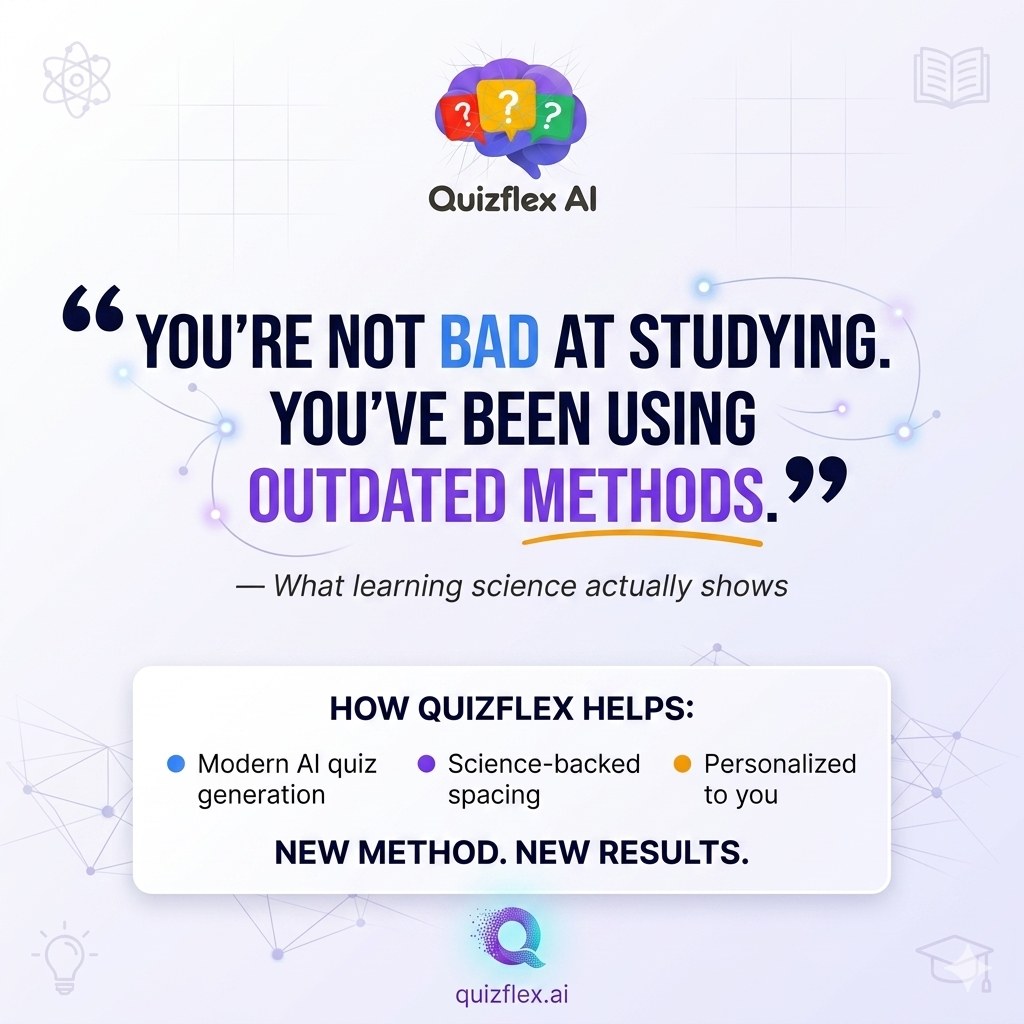
Here's a hard truth that might change how you study forever:

You're probably NOT bad at studying. 🧠

You've just been using methods that don't work — and most of us have, because that's what we were taught.

Re-reading the same chapter 5 times? That's "outdated."
Highlighting until your textbook glows? "Outdated."
Cramming the night before? Definitely "outdated."

These methods FEEL productive. Your brain mistakes effort for learning.

But research from cognitive psychology shows that modern, science-backed methods produce 50%+ better retention with LESS time spent.

The new way:
🧠 Active recall — testing yourself triggers real learning
🔁 Spaced repetition — reviewing at smart intervals
📊 Adaptive practice — focusing on what you don't know yet

Quizflex AI is built around these exact principles. Drop your notes in. Get a smart quiz. Practice at the right intervals. Master the material faster than you thought possible.

You're not bad at
Why This Matters for Learners
Short visuals, like the infographic above, can serve as excellent starting points for your study sessions. They offer a quick overview and highlight key concepts before you dive deep into your notes or textbooks. However, to truly make that information stick, you need to pair these previews with active learning strategies. This is where tools like quizzes, flashcards, and self-checks become invaluable. By actively engaging with the material, you transform passive reading into meaningful learning.
Turn Any Material into a Powerful Quiz
Ready to ditch the ineffective study habits and embrace a smarter, science-backed approach? Quizflex AI is your solution. Our AI can read your PDFs and notes, and then automatically build a comprehensive set of practice questions. Whether you prefer multiple-choice, fill-in-the-blank, matching, or short-answer formats, Quizflex AI creates them for you. You can then use these quizzes for self-testing, share them with study groups, or even embed them on your own platforms. Experience the difference that active learning, powered by AI, can make in your academic success.
Related: Blog home · Pricing · AI quiz generator
Topics covered
- Quizflex
- Infographic
- Study tips
- AI quiz generator
- quiz maker for teachers
- study tips
- active recall
- quiz from notes
- PDF to quiz
Frequently asked questions
What is Here's a hard truth that might change how you study forever: You're probably NOT bad at studying. 🧠?
How do I study Here's a hard truth that might change how you study forever: You're probably NOT bad at studying. 🧠 effectively?
What is the best AI quiz tool for Here's a hard truth that might change how you study forever: You're probably NOT bad at studying. 🧠?
How can I practice Here's a hard truth that might change how you study forever: You're probably NOT bad at studying. 🧠 with QuizFlex AI?
Is QuizFlex AI free for students and teachers?
Stay in the Loop
Get weekly tips on AI-powered learning, quiz strategies, and product updates. No spam, unsubscribe anytime.
🍎 Newton called it 300+ years ago - and physics still runs on his three rules. Every time you slam
Think you remember the water cycle from school? 💧Most people get 6 out of 7… but always blank
Related Articles
Continue learning with these related posts
POV: it's 11pm, exam's tomorrow, and you've got 80 pages of notes you haven't touched 💀 stop. breat
POV: it's 11pm, exam's tomorrow, and you've got 80 pages of notes you haven't touched 💀 stop. breathe. upload. Quizflex AI turns your notes, PDFs, or rand…
You made it 30 days with us.
You made it 30 days with us. - concepts, study ideas, and practicing with Quizflex AI.
Think you remember the water cycle from school? 💧Most people get 6 out of 7… but always blank
Think you remember the water cycle from school? 💧 Most people get 6 out of 7… but always blank on this one stage. 👀 Can you name what goes in the yellow…