Your Body's Unseen Army: How Your Immune System Fights Back Every Single Day
Right now, countless microscopic invaders are attempting to breach your defenses. It's a constant, silent battle happening within you, and the incredible news is: your body is winning. Every. Single. Day. Your immune system is a marvel of biological engineering, a complex network of cells, tissues, and organs working in harmony to protect you from illness. Understanding how it operates can be a game-changer for your studies, especially if you're delving into biology, anatomy, or health sciences.
This article breaks down the four fundamental stages of your immune response, offering a clear and concise overview. Think of it as your quick study reference. When you're ready to deepen your understanding and test your knowledge, remember that you can transform your own notes and PDFs into interactive quizzes with Quizflex AI.
The Constant Battle: A Microscopic Perspective
You're surrounded by a world teeming with microorganisms. Bacteria, viruses, fungi, and other pathogens are everywhere – in the air you breathe, on the surfaces you touch, and even within your own body. While many of these are harmless or even beneficial, a significant number have the potential to cause disease. Your immune system's primary role is to distinguish between "self" (your own cells) and "non-self" (invaders) and to neutralize any threats it identifies.
This defense isn't a passive process. It's an active, dynamic system that operates on multiple levels, employing a sophisticated strategy to identify, contain, and eliminate threats. Let's explore the four key stages of this remarkable defense mechanism.
Stage 1: Barrier Defense – The First Line of Fortification
Before any internal defense can be mounted, your body has a robust external defense system in place. This is your Barrier Defense, and it's incredibly effective. Think of it as the walls and moats of a castle, designed to prevent invaders from ever reaching the inner sanctum.
- Your Skin: This is your largest organ and a formidable barrier. Its tough, waterproof outer layer, the epidermis, physically prevents most pathogens from entering. The slightly acidic pH of your skin also creates an environment that is hostile to many bacteria.
- Mucous Membranes: These line your respiratory, digestive, urinary, and reproductive tracts. They produce mucus, a sticky substance that traps pathogens. Tiny hair-like structures called cilia then sweep the mucus and trapped invaders away, often to be swallowed or expelled.
- Tears and Saliva: Your tears contain enzymes like lysozyme, which can break down bacterial cell walls. Saliva also has antimicrobial properties and helps wash away food particles and microbes from your mouth.
- Stomach Acid: The highly acidic environment of your stomach is lethal to many ingested pathogens.
These physical and chemical barriers are incredibly efficient, blocking an estimated 99% of invaders before they even have a chance to penetrate your body. However, no barrier is impenetrable, and sometimes, pathogens find a way through.
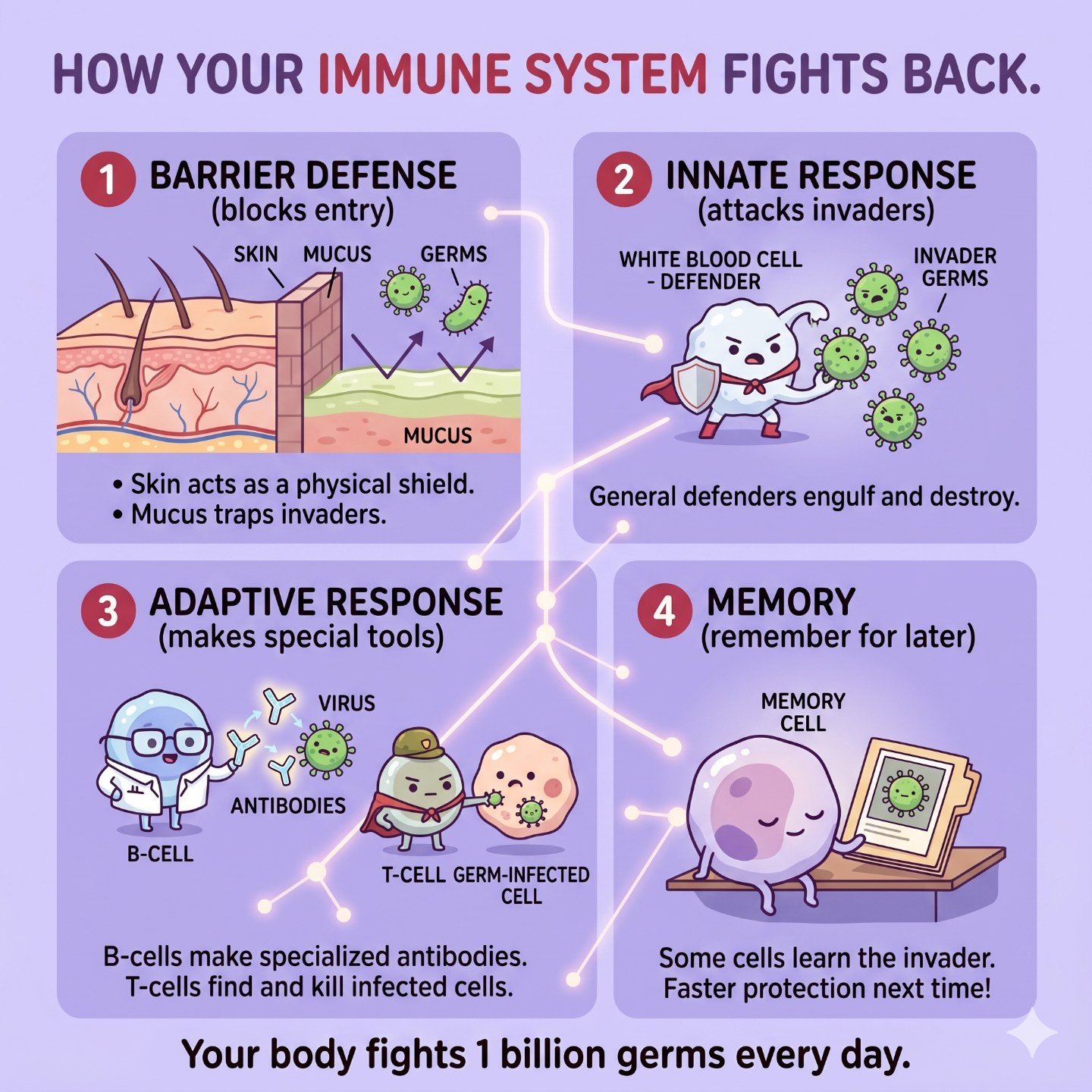
Stage 2: Innate Response – The Rapid, Non-Specific Army
When pathogens manage to bypass your barrier defenses, your Innate Immune Response kicks in. This is your body's immediate, generalized reaction to any foreign invader. It's not specific to any particular type of pathogen; it's a rapid, all-hands-on-deck approach to deal with the immediate threat.
Key players in the innate response include:
- Phagocytes: These are a type of white blood cell, with the most prominent being neutrophils and macrophages. Their primary job is to engulf and digest (phagocytose) invading microorganisms and cellular debris. They act like cellular Pac-Men, patrolling your tissues and consuming anything that looks foreign or damaged.
- Natural Killer (NK) Cells: These cells are specialized in recognizing and killing cells that have been infected by viruses or have become cancerous. They don't need to be "taught" to recognize a specific threat; they can identify abnormal cells and eliminate them quickly.
- Inflammation: This is a crucial part of the innate response. When tissues are injured or infected, they release chemical signals that cause blood vessels to dilate and become more permeable. This allows more immune cells and fluid to reach the affected area, bringing in reinforcements and helping to contain the infection. You recognize this as redness, swelling, heat, and pain.
- Fever: An elevated body temperature can inhibit the growth of some pathogens and enhance the activity of certain immune cells.
The innate response is vital because it buys your body time to mount a more specific and targeted defense. It's the first responder, working tirelessly to contain the damage and alert the more specialized branches of your immune system.
Stage 3: Adaptive Response – The Precision Strike Force
If the innate immune system can't clear the infection, your body calls upon its most sophisticated defense: the Adaptive Immune Response. This system is characterized by its specificity and its ability to "learn" and "remember" pathogens. It's a slower response to initiate, but it's incredibly powerful and precise.
The adaptive immune response is primarily mediated by two types of lymphocytes:
-
B-Cells: These cells are responsible for humoral immunity, which involves producing antibodies. When a B-cell encounters a specific antigen (a unique molecule on the surface of a pathogen), it becomes activated. With help from T-cells, it differentiates into plasma cells, which churn out vast quantities of antibodies. Antibodies are Y-shaped proteins that circulate in your blood and lymph. They don't directly kill pathogens, but they can:
- Neutralize: Bind to toxins or the pathogen itself, preventing it from harming your cells.
- Opsonize: Coat pathogens, making them easier for phagocytes to engulf.
- Activate Complement: Trigger a cascade of proteins that can directly destroy pathogens or enhance inflammation.
-
T-Cells: These cells are responsible for cell-mediated immunity. There are several types of T-cells, but two key ones are:
- Helper T-Cells (CD4+ T-cells): These are like the generals of the immune system. They don't kill pathogens directly but are crucial for activating other immune cells, including B-cells and cytotoxic T-cells. They "help" orchestrate the entire adaptive response.
- Cytotoxic T-Cells (CD8+ T-cells): These are the assassins. They directly recognize and kill infected body cells or cancerous cells. They bind to the abnormal cell and release toxic substances that induce programmed cell death (apoptosis), effectively eliminating the threat from within.
The adaptive immune response is highly targeted, ensuring that only the specific pathogen causing the problem is attacked. This precision minimizes damage to your own healthy tissues.
Stage 4: Memory – The Long-Term Defense Strategy
Perhaps the most remarkable aspect of the adaptive immune system is its ability to develop Immunological Memory. After an infection has been cleared, some of the B-cells and T-cells involved in the response don't disappear. Instead, they transform into long-lived memory cells.
These memory cells are like a highly trained intelligence agency, keeping a detailed record of past invaders. If the same pathogen attempts to infect your body again, these memory cells are primed and ready.
- Faster Response: Upon re-exposure, memory cells are quickly activated, leading to a much faster and more robust immune response than during the initial infection.
- Stronger Response: They can produce antibodies more rapidly and in higher quantities, and cytotoxic T-cells can be deployed more effectively.
This is why you typically only get certain diseases, like chickenpox, once. Your immune system remembers the virus and can swiftly eliminate it before it has a chance to cause significant illness. This principle of immunological memory is also the foundation of vaccination. Vaccines introduce a weakened or inactive form of a pathogen, or specific components of it, to your immune system. This allows your body to develop memory cells without you having to endure the actual disease, providing protection for the future.
Mastering Your Biology Studies with Active Recall
Understanding the intricate workings of your immune system is a cornerstone of many scientific disciplines. Whether you're a high school student grappling with basic biology, a pre-med student preparing for advanced coursework, or a medical student diving deep into immunology, active recall is key to truly mastering the material.
Simply reading about these stages isn't enough. You need to engage with the information, test your understanding, and identify areas where you need further clarification. This is where tools like Quizflex AI can be incredibly beneficial.
Imagine taking all your lecture notes, textbook chapters, and even your own handwritten summaries and instantly transforming them into a personalized study toolkit. With Quizflex AI, you can generate multiple-choice questions, fill-in-the-blank exercises, matching activities, and short-answer prompts based on your specific content. This allows you to:
- Practice Active Recall: Force yourself to retrieve information from memory, strengthening neural pathways.
- Identify Knowledge Gaps: Discover what you don't fully understand so you can focus your study efforts.
- Reinforce Concepts: Repeatedly engaging with the material in a quiz format helps solidify your learning.
- Save Time: Automate the process of creating study materials, freeing up more time for actual learning and review.
Don't just passively consume information. Actively engage with it. Turn your notes into quizzes and watch your understanding of complex biological systems, like your immune system, grow.
What we posted
Caption (as published on social):
Right now, 1 billion germs are trying to infect you. 🦠
And right now, your body is winning. Every. Single. Day.
Here's how your immune system actually fights back — in 4 stages:
🛡️ 1. Barrier Defense — Your skin and mucus block 99% of invaders before they even get in.
⚔️ 2. Innate Response — White blood cells engulf and destroy anything that breaks through.
🎯 3. Adaptive Response — B-cells make custom antibodies. T-cells hunt and kill infected cells. Targeted, lethal, precise.
🧠 4. Memory — Specialized cells "remember" the invader. Next time, your response is faster and stronger.
That's why you usually only catch chickenpox once. That's also why vaccines work — they teach your memory cells without you ever getting sick.
📚 Studying biology, anatomy, or health science? Drop your notes into Quizflex AI and get instant flashcards, practice questions, and AI-explained answers. Master complex systems faster. 🧠
🔗 quizflex.ai
Save this for your next bio test 📌
#Biology #ImmuneSystem #HumanBody #BiologyStudent #PreMed #StudyGram #StudentLife #ExamPrep #QuizflexAI #Anatomy #Physiology #ScienceFacts #STEM #HighSchoolBiology #MedSchool #StudyTips #BiologyClass
Topics covered
- Quizflex
- Infographic
- Study tips
- Biology
- Immunesystem
- Humanbody
- Biologystudent
- Premed
- Studygram
- Studentlife
Frequently asked questions
What is Right now, 1 billion germs are trying to infect you. 🦠 And right now, your body is winning. Every.?
How do I study Right now, 1 billion germs are trying to infect you. 🦠 And right now, your body is winning. Every. effectively?
What is the best AI quiz tool for Right now, 1 billion germs are trying to infect you. 🦠 And right now, your body is winning. Every.?
How can I practice Right now, 1 billion germs are trying to infect you. 🦠 And right now, your body is winning. Every. with QuizFlex AI?
Is QuizFlex AI free for students and teachers?
Stay in the Loop
Get weekly tips on AI-powered learning, quiz strategies, and product updates. No spam, unsubscribe anytime.
Quizflex for Corporate Training: A Complete Guide to Revolutionizing Employee Development
The Water Cycle Explained: A Complete Guide to How Earth's Water Moves
Related Articles
Continue learning with these related posts
The most popular study method is also one of the LEAST effective. 📚 Re-reading your notes feels pro
The most popular study method is also one of the LEAST effective. 📚 Re-reading your notes feels productive. It feels like work. It even feels like learnin…
Studying for 5 hours straight doesn't make you a better student. ⏱️ It usually means you'll forget m
Studying for 5 hours straight doesn't make you a better student. ⏱️ It usually means you'll forget most of it within 24 hours. Here's the truth nobody tell…
Mitral stenosis - every med student needs to memorize this. 🫀 Mitral stenosis is the narrowing of t
Mitral stenosis - every med student needs to memorize this. 🫀 Mitral stenosis is the narrowing of the mitral valve, restricting blood flow from the left a…