The Most Popular Study Method Is Also One of the Least Effective. 📚
You've probably been there. Staring at your notes, highlighting sentences, and re-reading paragraphs over and over. It feels productive, right? It feels like you're actively engaging with the material, making progress, and truly learning. But what if this deeply ingrained habit is actually holding you back from achieving your academic goals?
The truth, backed by a wealth of research in learning science, is that re-reading is one of the least effective study methods for long-term retention. While it might give you a temporary sense of familiarity, it rarely translates into deep understanding or the ability to recall information when you need it most – like during an exam.
The Illusion of Knowing: Why Re-reading Fails
Re-reading often creates a false sense of mastery. When you encounter information you've already seen, your brain recognizes it. This recognition can be easily mistaken for genuine recall. You might think, "Oh yeah, I remember this," but in reality, you're just recognizing the words on the page. This "fluency illusion" is a common pitfall that leads students to believe they've learned more than they actually have.
Think about it: when you're re-reading, you're passively absorbing information. Your brain isn't being challenged to retrieve that information from memory. It's like looking at the answers to a puzzle instead of trying to solve it yourself. You see the pieces fit, but you didn't do the work of figuring out how they connect.
The Science of Studying: Active Recall is Your Secret Weapon
Fortunately, there's a powerful, science-backed alternative: active recall. This method involves actively retrieving information from your memory, rather than passively reviewing it. It's the closest thing to a "cheat code" for studying because it directly strengthens your memory pathways and provides a true measure of your understanding.
How does active recall work its magic?
- Forced Retrieval: When you try to recall information, you're forcing your brain to access and pull that knowledge from your long-term memory. This effortful retrieval process is what makes the memory stronger and more durable.
- Strengthening Connections: Each time you successfully retrieve a piece of information, you reinforce the neural pathways associated with it. This makes it easier to access that information in the future.
- Identifying Knowledge Gaps: Active recall is an incredibly effective diagnostic tool. By testing yourself, you quickly discover what you truly know and, more importantly, what you don't know or only have a vague familiarity with. This allows you to focus your study efforts where they are most needed.
The Power of Testing: One Test Beats Re-reading Five Times
The evidence for active recall is compelling. Studies consistently show that even a single instance of testing yourself on material significantly outperforms multiple instances of re-reading. Imagine this: one brief self-test can be five times more effective than spending the same amount of time re-reading your notes. This isn't just a theory; it's a principle grounded in over 100 peer-reviewed studies of learning science.
When you engage in active recall, you're not just memorizing facts; you're building a robust understanding that allows you to apply knowledge in different contexts. This is crucial for success in any academic endeavor, from passing exams to mastering complex subjects.
Stop Reading, Start Testing: Your Path to Smarter Studying
The shift from passive re-reading to active recall can be transformative. It requires a change in mindset and study habits, but the rewards – deeper learning, better retention, and improved academic performance – are well worth the effort.
Here's how you can start incorporating active recall into your study routine:
- Flashcards: Create flashcards with questions on one side and answers on the other. Test yourself regularly.
- Practice Questions: Work through practice problems, quizzes, and past exam papers.
- Summarization: After reading a section, close your notes and try to summarize the key points in your own words.
- Teaching Others: Explain a concept to a friend, family member, or even an imaginary audience. This forces you to articulate your understanding.
- Concept Mapping: Draw diagrams or mind maps to connect different ideas and concepts.
Quizflex AI: Your Partner in Active Recall
We understand that creating effective active recall exercises can sometimes be time-consuming. That's where Quizflex AI comes in. Our AI-powered study app is designed to transform your existing study materials into engaging practice quizzes.
Simply upload your notes, PDFs, lecture slides, or even paste text from articles, and Quizflex AI will generate a variety of question types – multiple-choice, fill-in-the-blank, matching, and short-answer – tailored to your content. This allows you to:
- Instantly Generate Quizzes: Save time and effort by letting our AI do the heavy lifting.
- Trigger Active Recall: The quizzes are designed to prompt you to retrieve information, not just recognize it.
- Identify Weaknesses: Quickly pinpoint areas where your understanding needs reinforcement.
- Study Smarter, Not Harder: Focus your precious study time on what truly matters for retention.
Imagine turning a dense PDF textbook chapter or your messy handwritten notes into a personalized quiz in minutes. With Quizflex AI, you can move beyond passive re-reading and embrace a study method that is scientifically proven to enhance learning and memory.
The Social Proof: What We're Sharing
We believe so strongly in the power of active recall that we've created content to share this message across our social platforms. Here’s a glimpse of what we've posted on Instagram and Facebook:
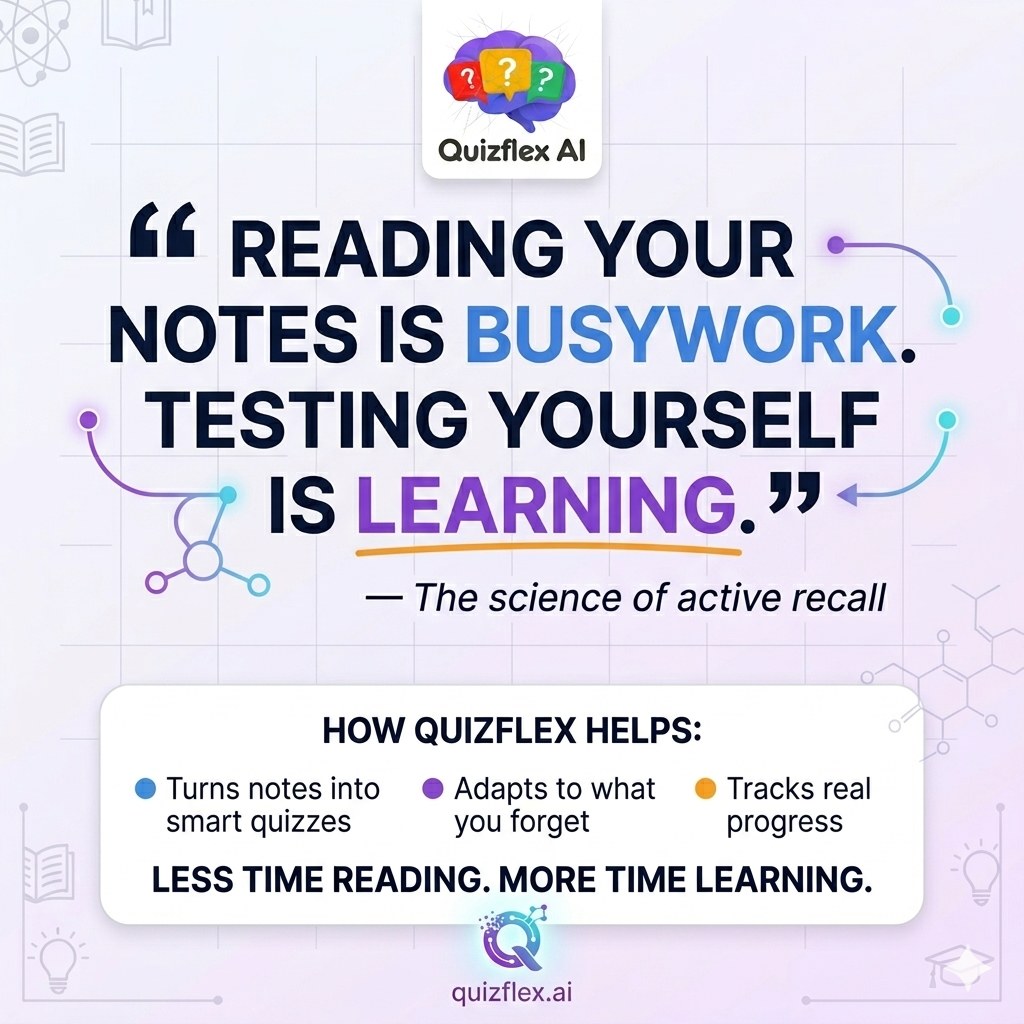
The most popular study method is also one of the LEAST effective. 📚

Re-reading your notes feels productive. It feels like work. It even feels like learning.

But research is brutal: re-reading produces almost no long-term retention.

Testing yourself even ONCE outperforms re-reading 5 times. That's not opinion — that's 100+ peer-reviewed studies of learning science.

This is called "active recall," and it's the closest thing to a cheat code that exists for studying:

🧠 You force your brain to retrieve information (not just recognize it)
🔁 Each retrieval strengthens memory pathways
📊 You quickly identify what you actually know vs. what just "feels familiar"

Stop reading. Start testing.

Quizflex AI turns any topic — your notes, PDFs, lecture slides, YouTube videos — into instant quizzes designed to trigger active recall. No more passive re-reading. Just smart, science-backed practice.

Less time reading. More time learning.

🔗 quizflex.ai

Save this for your next study session 📌

#StudyTips #ActiveRecall #StudySmart #StudyMotivation #StudentLife #StudyGram #ExamPrep #QuizflexAI #LearningScience #StudyHacks #AcademicSuccess #StudyMethod #StudentSuccess #StudyTruth #SmartStudy
And here is the embed for that Instagram post:
Making the Switch: Practical Steps for Learners
Transitioning to active recall might feel challenging at first. It's natural to gravitate towards methods that feel easier. However, the "desirable difficulty" of active recall is precisely what makes learning stick.
- Start Small: Don't try to overhaul your entire study system overnight. Begin by incorporating one or two active recall techniques into your next study session.
- Be Consistent: Regular practice is key. The more you engage in active recall, the more proficient you'll become, and the more your memory will benefit.
- Embrace Mistakes: See incorrect answers not as failures, but as valuable feedback. They highlight exactly where you need to focus your efforts.
- Use Tools Wisely: Leverage tools like Quizflex AI to make active recall more accessible and efficient.
The Future of Studying is Active
The goal of studying isn't just to get through a course; it's to build lasting knowledge and skills that will serve you throughout your life. By understanding the science of how we learn best, you can optimize your study habits for maximum impact.
Re-reading might feel like the comfortable, familiar path, but active recall is the road to genuine understanding and long-term retention. It’s time to ditch the highlighter fatigue and embrace the power of testing yourself.
Ready to transform your study experience? Explore how Quizflex AI can help you turn your notes and PDFs into powerful active recall quizzes. Less time spent passively reviewing, more time spent actively learning and mastering your subjects.
Related: Blog home · Pricing · AI quiz generator
Topics covered
- Quizflex
- Infographic
- Study tips
- Studytips
- Activerecall
- Studysmart
- Studymotivation
- Studentlife
- Studygram
- Examprep
Frequently asked questions
What is The most popular study method is also one of the LEAST effective. 📚 Re-reading your notes feels pro?
How do I study The most popular study method is also one of the LEAST effective. 📚 Re-reading your notes feels pro effectively?
What is the best AI quiz tool for The most popular study method is also one of the LEAST effective. 📚 Re-reading your notes feels pro?
How can I practice The most popular study method is also one of the LEAST effective. 📚 Re-reading your notes feels pro with QuizFlex AI?
Is QuizFlex AI free for students and teachers?
Stay in the Loop
Get weekly tips on AI-powered learning, quiz strategies, and product updates. No spam, unsubscribe anytime.
Embrace the learning process; it's not just about the destination, but the DISCOVERY along the way.
Think you remember the water cycle from school? 💧Most people get 6 out of 7… but always blank
Related Articles
Continue learning with these related posts
Studying for 5 hours straight doesn't make you a better student. ⏱️ It usually means you'll forget m
Studying for 5 hours straight doesn't make you a better student. ⏱️ It usually means you'll forget most of it within 24 hours. Here's the truth nobody tell…
The Water Cycle Explained: A Complete Guide to How Earth's Water Moves
Discover how the water cycle works in 4 stages - evaporation, condensation, precipitation, and collection. A complete student-friendly guide.
Confusion is not FAILURE. It is the BRAIN wiring new connections. - Desirable difficulties spee
Confusion is not FAILURE. It is the BRAIN wiring new connections. - Desirable difficulties speed durable le… How Quizflex AI helps you practice and remember.